
Background
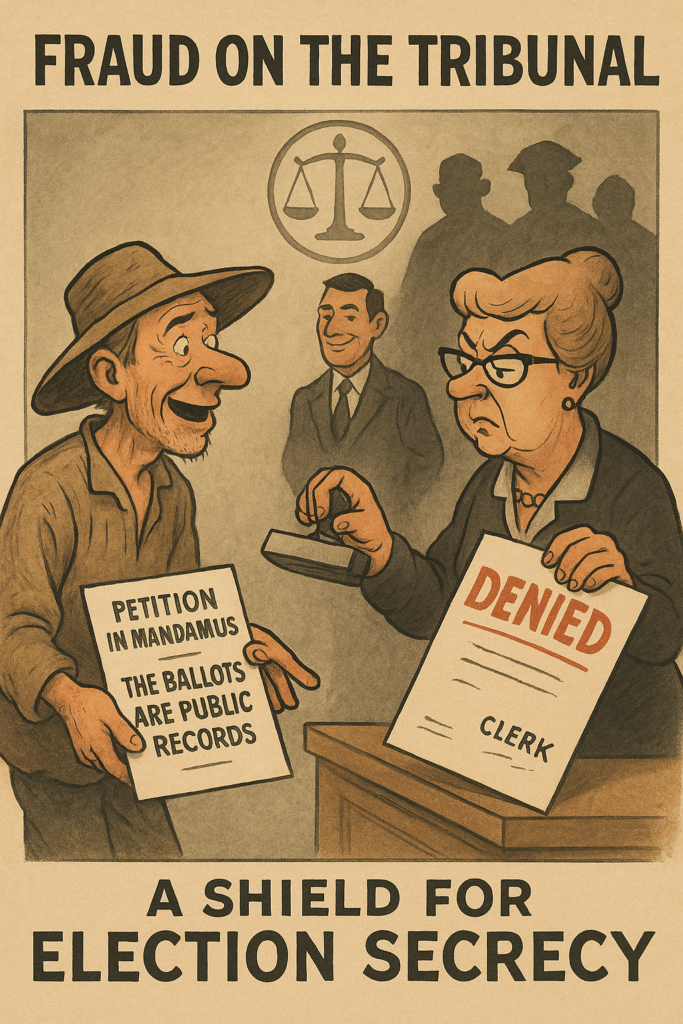
In May 2022, I ran for State Senate in Lancaster County, Pennsylvania. On Election Day, County officials made a stunning announcement: approximately 14,000 of the 22,000 ballots the County received from ‘mail-in’ voters could not be counted by County’s scanners because the ballots had been misprinted. (the clerk testified that 8,000 ballots scanned without error). Even worse, County staff testified that some ballots sent to voters in my district didn’t include my race at all. Those voters never had the chance to vote for me. To ‘fix’ this, the County ordered employees to fill out and count 14,000 “replacement ballots” instead of the ones returned by voters. The certified vote totals were based on the substitute ballots–not the originals marked by voters.
State Litigation — From Transparency to Censorship
After the election, I filed a Right-to-Know Law request for copies of the voted mail-in ballots. The Office of Open Records (OOR), the state’s transparency agency, agreed with me. It issued a “Final Determination” declaring that mail-in ballots are public records under state law 25 P.S. §§ 3146.9(a) and 3150.17(a). The law couldn’t be clearer: “all official mail-in ballots are designated and declared to be public records.”
Yet County officials refused to release the records. Officials imposed absurd “conditions” for access—inspection-only, in two-hour blocks, nno copies, no photography, and I had to b
e alone under a sheriff’s supervision. A right of access turned into a performance meant to block disclosure.
When I returned to the OOR to enforce its own ruling, its chief counsel disclaimed authority and told me to file a lawsuit. In December 2022, I did. But in May 2023, the County’s Court of Common Pleas terminated my case without a hearing—acknowledging the petition stated a valid claim but refusing even to let me amend it. The court conducted no fact-finding and allowed no briefing.
The Commonwealth Court affirmed the termination, also without hearing, ignoring rules on dismissal and ignoring its own decision in Previte v. Erie County Board of Elections, which confirmed that voted ballots are indeed public under the RTKL.
The Pennsylvania Supreme Court ended my appeal with an unsigned, clerk-certified order stamped “PER CURIAM–BY THE COURT”. No Justice signed it. When I objected, another clerk—not a Justice—rejected the objection and terminated the case.
That entire chain—administrative dodge, judicial shortcut, and clerk-issued closure—is now the subject of my pending Application to Vacate Orders for Fraud on the Tribunal to v
acate those orders as fraud on the court.
Federal Cases — The Same Pattern, Different Courts
The same pattern has repeated in federal court.
In January 2024, after the County still refused to produce the records, I filed a declaratory-judgment action in the Middle District of Pennsylvania. The magistrate judge blurred the difference between jurisdiction and the merits—something the law forbids—and the district judge rubber-stamped the result without holding a single hearing.
On appeal (No. 24-2934), an administrative assistant named “Nicole” in the Third Circuit Clerk’s Office allegedly wrote and issued a “summary-action” letter without judicial order (ECF 7), which suspended briefing. Eight months later, the clerk entered a “judgment” terminating the case signed only by the Clerk—no judicial signatures appear.
In total, nearly 140 filings were disposed of without jurisdiction, a hearing, or any ruling on the merits—what I call obstruction by fraud.
Concurrently, I filed two other federal cases—E.D. Pa. 5:24-cv-05338 (appeal 25-2570) and E.D. Pa. 5:25-cv-04633 (appeal 25-2616). These cases show identical patterns: no hearings, no signatures, and no judicial act on the merits.
I have now filed an Application for Supervisory Relief in the U.S. Supreme Court under Rules 22, 23, and 11, seeking to stay and vacate those void judgments. The legal standard is the same as the one the Court applied in Trump v. Slaughter (2025)—where it intervened directly to clarify constitutional boundaries before appellate judgment.
My argument is simple: when a clerk signs instead of a judge, there is no judgment and no due process of law. Ironically, the Supreme Court’s Clerk has refused to transmit the application to Justice Alito (See Rule 22), creating yet another procedural blockade within the same closed loop.
The Closed Loop
Across state and federal systems, the pattern is identical:
-
Clerks issue orders without judges.
-
Judges ratify the clerks’ acts without review.
-
Complaints about misconduct go back to the same offices that caused it.
Every branch shields its own mistakes, and the loop closes.
Why It Matters
This isn’t about one election or one litigant. It’s about whether “justice” in America still means decisions by judges or whether the system now runs by automated clerical fiat.
The Constitution’s design assumes mutual correction, if one branch falters, another must act. Congress can investigate misuse of judicial appropriations. The Executive can refuse to defend judgments obtained by fraud. The Judiciary can—and must—vacate counterfeit rulings.
My filings are stress tests for the system. They ask whether the rule of law still governs those who administer it. The answer will determine whether ordinary citizens can still reach a real judge—or only the clerical gatekeepers who stand in the way.
Judges must judge. Clerks must clerk. And public law must remain public.
For oversight committees, reform advocates, and the public, my cases offer a blueprint for identifying structural fraud: where form replaces substance, and adjudication is replaced by administration. The remedy begins with sunlight.
Links to Website and Filings on Court Listener
- Website: showmetheballots.net
- 24-2934: https://www.courtlistener.com/docket/69829520/michael-miller-v-county-of-lancaster/?order_by=desc
- 25-2570: https://www.courtlistener.com/docket/71100409/michael-miller-v-county-of-lancaster/
- 25-2616: https://www.courtlistener.com/docket/71174376/michael-miller-v-judicial-council-united-states-third-circuit-court/